Coordinated Grouse Hunts: Step-by-Step Tips for Multiple Hunters
Dividing Cuts into Huntable Sections for More Grouse Flushes
Ann Jandernoa
August 25, 2025
Looking at Cuts Differently
Over the years, I’ve learned to look at cuts differently. It’s no longer, “Oh, there’s a cut, let’s go hunt it.” Instead, I ask, What does this cut actually offer a grouse?
Habitat Questions That Matter
Is this an area that improves their life or one that just makes them easier to kill? I start thinking about what surrounds the cut. How far is the nearest shrub component? Are there conifers mixed in? What’s the escape route like meaning does the bird have real exit strategies to escape danger or is it boxed in?
Width and Structure
Yes, many hunters look at stem density, shrubs, and regeneration. But let’s go one layer deeper: width of the cut. Does a trail run down the middle? If so, you’re looking at one of the easiest cuts to read and hunt. That trail gives you a lowland side and an upland side. So, which do you hit first?
The Lowland Approach
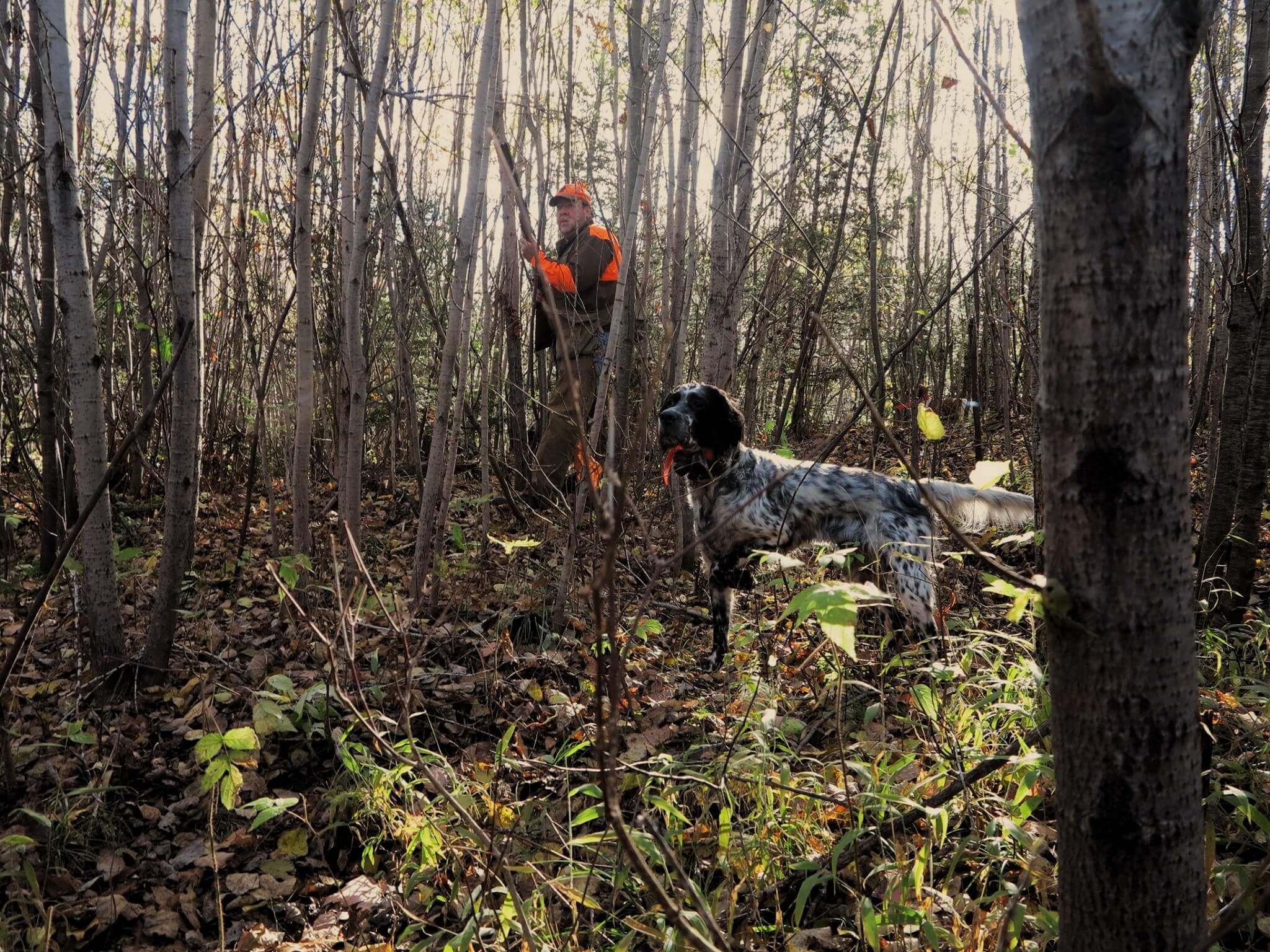
Me? I like to start with the lowland side. I never walk into a cut and then drop down. If there’s a bird holding on the edge of the cut and you march right in, you just blew your chance and pushed the bird into the lowland pines or tag alders. Instead, I’ll leave the trail about 150 feet before the cut, anchor one client about 50 feet from the lowland edge, just a bit ahead of me, and set the second client on the upland side, just off the trail also just a bit ahead of me. I run my dogs slightly past each of them and keep them under control.
Creating the Soft Wedge
That setup? It creates a soft wedge. My position would be in the center just a little bit back of each client which is on either side. One client has the lowland edge while the other has the trail edge. Each client is about 50 to 70 feet from their edge. And me managing pace and pressure in the middle.
Working the Pressure
I instruct the trail-side client: If my dog points, quietly step off onto the trail and move forward, but don’t talk to us. I want the bird focused on me and the lowland-side client, not the guy sneaking up on the flank. The key is pace. Move too fast, and the bird will push farther out. Keep it steady, keep the pressure light, and you’ll funnel that bird toward the center. If the dog’s on point, I’ll move the clients up quietly, hold them, then release the dog.
Where the Bird Wants to Go
If the bird flushes great. If it runs? Even better. My dog will stop on the flush, reestablish, and the direction of his body and nose tells the rest of the story. That’s your trail map for how the bird is trying to shift. Many times, the sound of a client walking nearby will make the bird pause as it’s trying to decide which direction is safe. That pause? That’s the key moment.
Controlled Pressure
All the while, I’m scanning ahead watching for any indication that the dog has scent and if so, how strong is the scent by the way the dog is acting. You need to keep scanning for where the bird wants to go. I’m looking for clumps of shrub, a patch of pines, blowdowns, anything that gives that grouse a place to slip into, hold tight, and hope we walk on by or escape behind us. Grouse aren’t just holding, they’re calculating.
The Dog’s Rhythm
My dog is used to this rhythm. He knows I’m setting the range, casting between each client, and with a light whistle I can turn him like a slow current in the woods. No yelling. No chaos. Just the natural noise of our boots and brush – nothing more.
More Than a GPS
This isn’t about chasing a GPS signal and pointing across the woods, saying, “Your dog’s 150 yards that way.” My job is to create opportunities and to let clients see the hunt through my eyes, to feel what it means when a dog works a cover with purpose, when a flush is earned, not stumbled on. For me the fun of all this is calculating the amount of pressure and shifting to force the flush and create an opportunity.
Cut Dimensions and Flow
The cut we worked would fluctuate between 45 and 65 yards wide, from the trail across to the lowland edge. The upper side, from trail to the hardwood line, was narrower than 25 to 45 yards depending on the pocket. That variation? That’s what gave us options.
Working the Hardwoods side Opposite Direction
I’d run one hunter on the trail and the other along the edge where the aspens met the hardwoods. The end of the cut funneled into straight hardwoods and I knew from experience, the birds liked to fly out the back and bank hard left or a longer straight away shot with a hard bank to the left back toward the lowland side. As we approached the end of the cut, I’d motion to the trail-side hunter to quietly move ahead until he was within about 50 feet of the end of the cut. Then I’d have the hardwood-edge hunter do the same, easing up that transition line until both were staged and in visual contact with each other. At this point we were less than 40 yards to the end of the cut. Each hunter would give me a hand signal when they were set and ready and could see each other.
When It All Clicks
Then with the hunters in place, I’d keep moving straight up the middle with the dog—calm, controlled, reading the cover. Then we’d get that final point. I’d call out, “Get ready.” And just like that, we’d trigger the endgame. My dog and I would make the last push, and the bird would either flush straight out or break hard left thus giving one hunter a straightaway, the other a clean crossing shot. Sometimes it was only one bird but other times it was multiple birds. It was always a challenge to time it just right, but when it worked, when it really came together. It was like pulling off a perfectly executed ambush with a dog, a plan, and a whole lot of stealth.
Breaking Down the Cut
This cut was each to dice up into runs like the one I just described. So, when you look at a cut. Think about how you would work it to your benefit and think about what are the key areas that a grouse needs and how the grouse may try to escape to denser cover in their own backyard. Plan the hunt, read the habitat, and know their needs. Pay attention to what each bird does and where did they escape to. You will then start recognizing the key areas within a cut and how to work a cut efficiently.